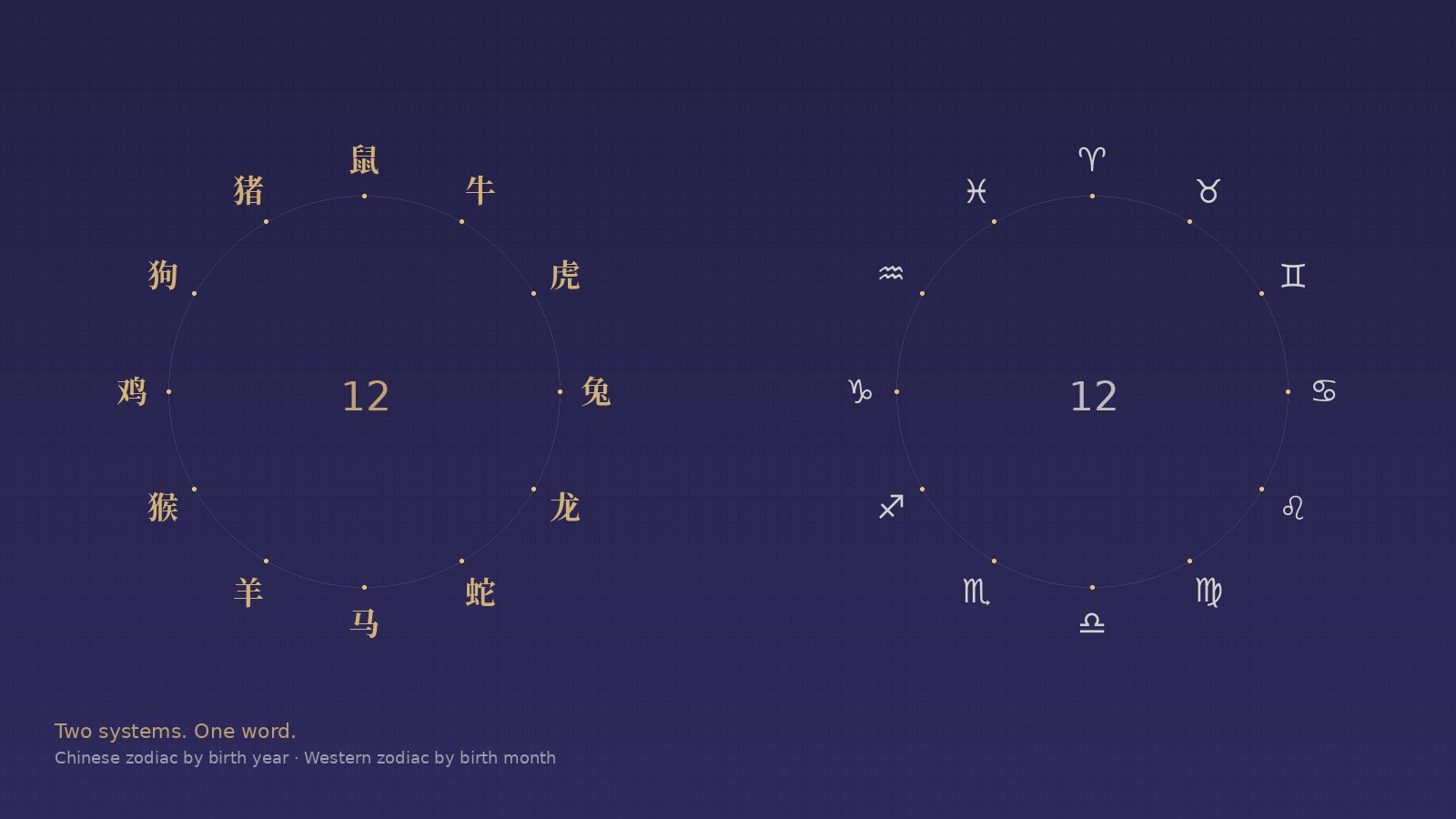
- They measure different things. The Chinese system sorts people by birth year; the Western one sorts by birth month.
- The Chinese zodiac runs on a 60-year cycle (12 animals × 5 elements × yin/yang). The Western one runs on a 12-sign tropical year keyed to the sun’s position.
- The elements do not convert. Wu Xing is Wood, Fire, Earth, Metal, Water — a cycle of phases. The Western set is Fire, Earth, Air, Water — a set of temperaments. There is no Air in the Chinese system and no Metal in the Western one.
- Every “Chinese sign = Western sign” chart you have seen is an analogy someone invented. It is not traditional, and it does not compute.
Contents
- What each system actually measures
- Why the two get compared at all
- The elements do not map
- What the Chinese system does not have
- What the Western system does not have
- Why the conversion charts fail
- How to use both without mixing them
- Questions
What each system actually measures
The Chinese zodiac is a calendar. Its unit is the year, and the year is defined by the solar term Lichun in early February, not by 1 January and not by Lunar New Year. Each year carries an animal, an element and a polarity, and those three together form one of sixty combinations that repeat on a fixed cycle.
The Western zodiac is a coordinate system for the sky. Its unit is the month: the ecliptic is divided into twelve 30-degree segments, and your sign is the segment the sun occupied at your birth. It then adds a second layer — planets in signs and houses — which is where most of the interpretive weight actually sits.
That difference in unit is the whole story. One system asks which year were you born in; the other asks where was the sun. Neither is a corrupted version of the other.
Why the two get compared at all
Because both are called “zodiac” and both have twelve members. The word itself comes from the Greek for “circle of little animals”, and the Western one kept the name from a tradition that once had animal figures too. Chinese 生肖 has no such etymology; it simply means “birth likeness”.
Twelve is the other reason. A cycle of twelve is memorable, fits a year of twelve months, and produces a tidy chart. Two unrelated systems arriving at twelve is not evidence that they describe the same thing — it is evidence that twelve is a convenient number.
The elements do not map
This is where most popular articles go wrong, so it is worth being blunt:
| Chinese Wu Xing | Western elements | |
|---|---|---|
| Members | Wood, Fire, Earth, Metal, Water | Fire, Earth, Air, Water |
| What they are | phases in a cycle that generate and overcome each other | temperaments attached to signs |
| Where they come from | the stem-branch calendar | Hellenistic cosmology |
| How you get yours | the year of your birth | the sign of your birth |
Wu Xing is a process model: Wood feeds Fire, Fire creates Earth, Earth bears Metal, Metal carries Water, Water nourishes Wood. Cut the cycle anywhere and it still describes a movement. The Western elements are a classification: each sign is assigned one, and the assignment does not change.
So “Fire” means something different in each system. A Fire Horse is a Horse in a Fire year — the Fire is a modifier on a year. A Fire sign in the Western system is a group of three signs sharing a temperament. The words collide; the concepts do not.
Notably, the Chinese system has no Air, which is the element the Western system uses for the intellectual signs. That absence alone should tell you a one-to-one chart is impossible.
What the Chinese system does not have
- No rising sign, no houses, no birth chart. There is no ascendant, because the system does not use the time of day that way. (The twelve double-hours exist, but they assign a branch to a time, not a personal chart.)
- No planets. The Chinese calendar’s astronomy is about the sun’s position and the moon’s phases, not about Mars in anything.
- No month signs. Your month matters in traditional reading, but not as a “sign” in the Western sense.
What the Western system does not have
- No 60-year cycle. Western astrology repeats annually; the Chinese cycle repeats every sixty years, which is why the combination of animal and element is the meaningful unit rather than the animal alone.
- No polarity by birth year. Yin and yang alternate year by year in the Chinese system. The Western equivalent is not assigned by year at all.
- No Lichun. The Western year starts at the March equinox for astrological purposes; the Chinese zodiac year starts at a solar term in early February. This is why your sign can be “wrong” on two Chinese sites — a boundary nobody in the Western system has to think about.
Why the conversion charts fail
The charts usually look like this: Aries → Dragon, Taurus → Snake, and so on. Three problems:
- They map a month onto a year. Even if the mapping were meaningful, you would be pairing a 30-day window with a 365-day one. Someone born on 1 April and someone born on 30 April share a Western sign but not a Chinese animal.
- They ignore the element. Each animal has five versions. Dragon years run from 1928 to 2036; a Wood Dragon and a Fire Dragon are different years, and the chart cannot express that.
- They are new. No classical Chinese text maps its animals onto Greek signs. The chart is a twentieth-century convenience for Western readers, and it was probably invented to sell books.
If you want a defensible comparison, compare the functions: both systems describe temperament, both divide people into types, both are used to talk about compatibility. That is a real comparison. Mapping the members is not.
How to use both without mixing them
- Get each answer from its own system. Your Chinese sign comes from your birth year, resolved through Lichun. Your Western sign comes from your birth date’s sun position. Do not derive one from the other.
- Keep the vocabularies separate. When a reading says “Fire”, check which system wrote it. When it says “element”, check whether it means Wu Xing or the Western four.
- Use them for different questions. The Chinese system is unusually good at describing a year’s character and the relationships between signs. The Western system is built for individual charts. Neither is a forecast, and neither overrides your circumstances.
If you have never checked your Chinese sign properly — including the boundary case that trips up most calculators — the calculator takes ten seconds and tells you which side of Lichun you fall on. The method page explains the calendar. And if you want the Chinese side read in depth rather than compared to something else, the five elements guide and the twelve sign pages are the honest starting points.
Questions
Is the Chinese zodiac more accurate than the Western one? That is not a question either system can answer, and any site that claims to has stopped describing tradition and started selling something. They measure different things.
Can I be both a Leo and a Dragon? Yes, and most people are two things at once: one from each system. They are separate labels, not competing answers.
Which Chinese animal matches my Western sign? None, properly. The popular charts are analogies, not conversions. If you want a meaningful pairing, compare the archetypes rather than the members.
Why does my Chinese sign change between websites? Because they disagree about the year boundary. The calculator shows the boundary note under every result, and the method page explains which convention we use.